
Work
Dragon Ball GT
One of two sequels to Dragon Ball Z
Dragon Ball GT is one of two sequels to Dragon Ball Z, whose material is produced only by Toei Animation and is not adapted from a preexisting manga series. The series spanned 64 episodes and is concluded by the TV special Dragon Ball GT: A Hero's Legacy.
Plot
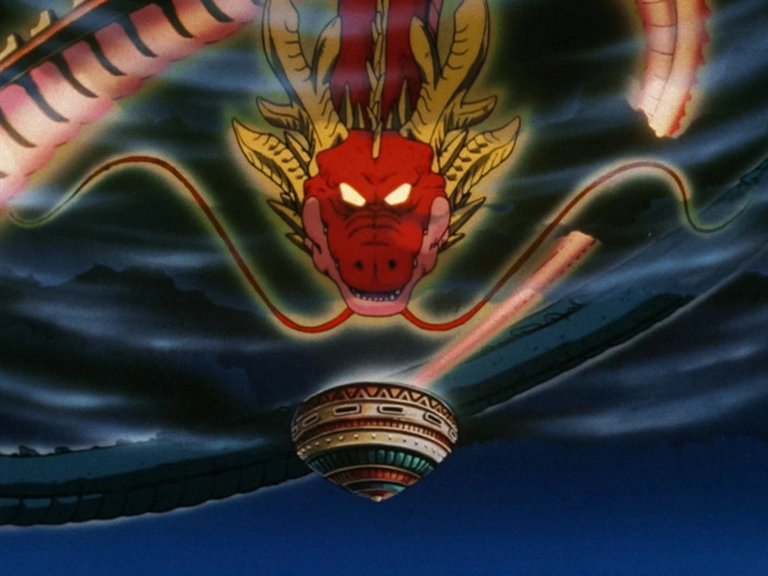
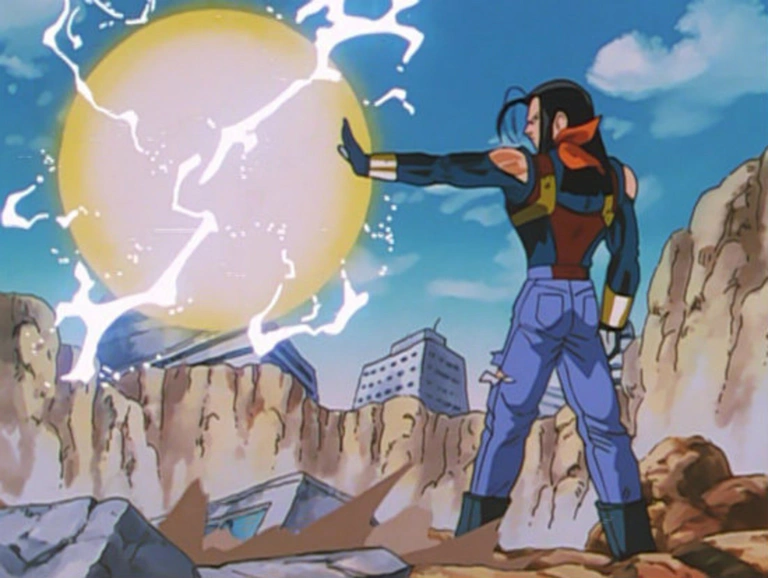
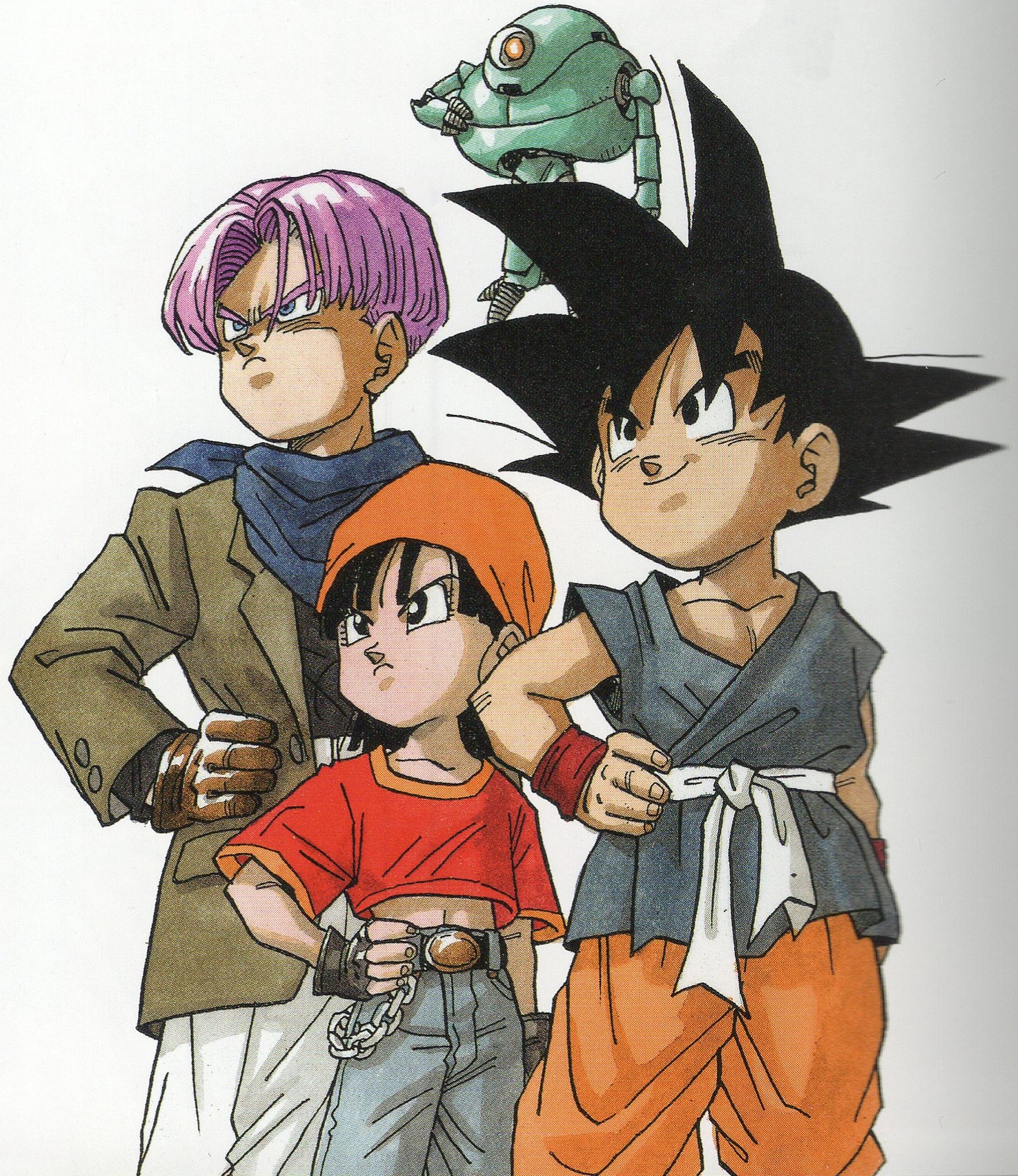
The series continues the adventures of Goku, who is turned back into a child by Emperor Pilaf accidentally wishing this using the Black Star Dragon Balls in the beginning of the series and is forced to travel across the galaxy to retrieve them. The first half of the series focuses on Goku, Pan, and Trunks, while the second half brings back most of the prominent characters from Dragon Ball and Dragon Ball Z. The series follows the Z Fighters against far more powerful foes such as the Luud Cult, the Machine Mutants, Baby, Super 17, and the Shadow Dragons.

The series is most commonly referred to as taking place 5 years after the Peaceful World Saga, though in promotional material for the English dub it was referred to as occurring 10 years later. It was also on one occasion instead referred to as taking place six years later.
Series History
The first two anime series were directly based off the Dragon Ball manga, which took much longer to produce than the anime did. This often resulted in "filler"; a notable instance being that the end of Goku's battle with Frieza lasts much longer than Frieza's predicted "five minutes". Since Dragon Ball GT was not based on the manga, no filler was required. As a result, four entire sagas (the Black Star Dragon Ball Saga, the Baby Saga, the Super 17 Saga, and the Shadow Dragon Saga) were completed in only 64 episodes. The music for Dragon Ball GT was composed and written by Akihito Tokunaga, replacing Shunsuke Kikuchi who is now retired after composing his last score for the final episode of Dragon Ball Z and the character designs for Dragon Ball GT were created by Katsuyoshi Nakatsuru.
Dragon Ball GT began on Fuji TV at 7:30 p.m. on Wednesday, February 7, 1996, exactly one week after the final episode of Dragon Ball Z. It ran for 64 episodes, the last of which aired on November 19, 1997. The series average rating was 14.6%, with its maximum being 19.7% (Episode 02) and its minimum being 9.6% (Episode 21). The series has also been aired across Japan by the anime television network, Animax, where it is currently being regularly broadcast. Unlike the Dragon Ball and Dragon Ball Z series, the creator Akira Toriyama had only minor involvement in the show's early stages, setting forth the initial premise of the series, as well as creating designs for most of the villains and main characters, including newcomer Giru. Early episodes are much more comedic in tone, reminiscent of early Dragon Ball. The later episodes, however, are action-packed and feature the same sort of dramatic tone that existed in Dragon Ball Z. The series ran for 64 episodes, ending after two years on the air. GT was followed by Dragon Ball Z Kai, a condensed remake of Dragon Ball Z, and Dragon Ball Super, which features a new plotline set directly after Dragon Ball Z, taking place between episodes 288 and 289 and began airing in the summer of 2015.

There are two companion books to the series, called the Dragon Ball GT: Perfect File, released in May 1997 and December 1997 by Shueisha's Jump Comics Selection imprint. They include series information, illustration galleries, behind-the-scenes information, and more. They were out of print for many years but were re-released in April 2006 and this edition is still in print.
On June 15, 2005, Toei Animation (in conjunction with distributor Pony Canyon) released the entire series (including the Gokū Jr. TV special) in an extremely limited-edition DVD boxed set (called "Dragon Box GT"), along with a Dragon Radar remote control and an exclusive booklet. While the set features remastered audio and video, there are no subtitles, English or otherwise. It's also unavailable to the general public due to its scarce numbers and its huge cost.
Toriyama's involvement and canon debate
Akira Toriyama is credited as author in the ending credits of Dragon Ball GT and oversaw the series' production. This was the same process that was used during the production of the anime series Dragon Ball and Dragon Ball Z. He came up with the name of the series, drew a rough design for the GT logo, designed the GT appearance of the series main cast, and the appearances of Giru and the Grand Tour Spaceship used in the Black Star Dragon Ball Saga. He also drew at least three color pictures of Goku, Pan, and Trunks adventuring on various planets (Monmaasu, Rudeeze, and an area in Hell). Toriyama drew a promotional version of Super Saiyan 4 Goku exclusively for the Dragon Box GT. Characters and events from GT have also been included in recent Dragon Ball video games.

Toriyama seems to have positive feelings towards his work's continuation. He refers to his fellow GT staff as "excellent", praising in particular the series animator, "animator Nakatsuru-kun is amazingly skilled, and mastered the peculiarities of my drawings". Toriyama has said that watching GT makes him happy, and that he enjoys it. On the same Dragon Box that Toriyama illustrated the Super Saiyan 4 form, he refers to the series as "a grand side-story of the original Dragon Ball". This controversial statement is interpreted by some fans to mean that the series is considered by Toriyama as an official continuation of his manga, and by others to mean the opposite. Some fans do not consider GT to be an official installment of the series, most often citing that the series was not directly adapted from a Toriyama manga. Like Dragon Ball and Dragon Ball Z, GT contains minor elements inconsistent with prior anime events. However, GT has the fewest inconsistencies of the first three anime series, making it difficult to burden the few that exist as a reason for the series to be set aside as unofficial.
In a Toei Animation a press statement about Battle of Gods on July 17, 2012, says the movie takes place "between the animation series "Z" and "GT", or in other words from the blank decade between the end of the battle with Majin Buu in chapter 517 of the manga and chapter 518, will be depicted for the first time." Some fans have taken this press statement as confirmation that GT is a part of continuity. In December 2014, Funimation English voice actor and voice director Christopher Sabat said that GT is "not even canon anymore", likely meaning that the release of Dragon Ball Z: Battle of Gods superseded GT as official content, in Sabat's opinion. Notably, Sabat's statement is one of very few recorded usages of the word "canon" by anyone involved in the production of any Dragon Ball media.
Sagas
Black Star Dragon Ball Saga (Episodes 1~16)
Baby Saga (Episodes 17~40)
Super 17 Saga (Episodes 41~47)
Shadow Dragon Saga (Episodes 48~64)
US (Funimation) version
The English adaptation of Dragon Ball GT ran on Cartoon Network between November 7, 2003 and April 16, 2005 and had reruns until June 13, 2005, but the version by FUNimation had a major alteration: the first 16 episodes of the series, the "Black Star Dragon Ball Saga", were cut and replaced by a single US-only episode which summarized the episodes; this became the new series premiere and the rest of the episodes began with episode 17. This edit was implemented by the producers of the English dub to prevent viewers from possibly being put-off by these differently toned early episodes. The 16 missing episodes have since been released as the "Lost Episodes". When first aired, Funimation recorded a new musical score composed by Mark Menza and the openings and closings were replaced with something completely different from the original. For example, a rap was used for the opening and used different clips from the show to make up the visuals. However, when FUNimation released the series to two remastered boxed sets in 2008, the original Japanese music was restored, and English versions of the opening and all four closings were created, which are all very close to the original versions. From early 2012 until January 2015, the FUNimation version, including the "lost episodes", was shown on Nicktoons.
International (Blue Water) version
Outside of the United States, (excluding Australia and New Zealand) a different English dub of the series was aired, featuring the voice actor of Canadian voice acting group Blue Water Studios. While the voices are different from both the American and international English dubs of Dragon Ball Z, the original background music by Akihito Tokunaga was kept, the episodes were aired in their proper order, and the scripts were kept much closer to the original Japanese version. An English version of the GT theme song was sung for the dub, however these were different lyrics to the original song and not a direct translation.
Live stage show
• Dragon Ball GT (live show)
TV special
Dragon Ball GT: A Hero's Legacy (悟空外伝! 勇気の証しは四星球 Gokū Gaiden! Yūki no Akashi wa Sūshinchū, lit. "Goku Sidestory! The Proof of his Courage is the Four-Star Ball")
Funimation Remastered Box Sets
In 2008 FUNimation began production of remastering the entire Dragon Ball GT series similar to the remastering process of Dragon Ball Z. Unlike the Dragon Ball Z remastered sets, the Dragon Ball GT Remastered Season Sets are presented in a 4:3 full frame and come with 5 discs rather than 6. The GT Sets are not presented in high definition. Just like the Dragon Ball Z remastered sets, the GT Sets include English dialogue with original Japanese background music, 5.1 surround sound, English dialogue with US broadcast stereo and original Japanese mono. Both Dragon Ball GT Season Box sets include a booklet including character profiles" and an episode guide.
Dragon Ball GT: Season One was released on December 9, 2008. The box set includes the Black Star Dragon Ball Saga and most of the Baby Saga, spanning the first 34 episodes over 5 discs.
Dragon Ball GT: Season Two was released on February 10, 2009. The box set includes the last six episode of the Baby Saga, Super 17 Saga and Shadow Dragon Saga, spanning the final 30 episodes concluding the series. The TV special Dragon Ball GT: A Hero's Legacy is included as part of the Box set.
On September 21, 2010, FUNimation released Dragon Ball GT: The Complete Series which featured all 64 episodes of the show and Dragon Ball GT: A Hero's Legacy.
Dragon Ball GT Season 1 DVD Cover.jpg
- Dragon Ball GT: Season 1 December 9, 2008 Black Star Dragon Ball and Baby Saga - Dragon Ball GT: Season 2 February 10, 2009 Super 17, Shadow Dragon Sagas and Dragon Ball GT: A Hero's Legacy - Dragon Ball GT: The Complete Series September 21, 2010 All 64 episodes and Dragon Ball GT: A Hero's Legacy
Manga
The "Anime Comics" manga version of Dragon Ball GT began in the January 2014 issue of Saikyō Jump, starting with the Evil Dragons Arc. Because the original story comes from an anime rather than a manga, this media is sometimes referred to as an animanga, a portmanteau of "anime" and "manga".

Presented in full color (as opposed to the limited-color version from serialization), Shueisha released the first three volumes of Dragon Ball GT on December 4, 2019, with pricing for ¥1,000 each (plus tax), and covered the entirety of the series' Evil Dragons arc. Previously, the Dragon Ball GT anime comic was exclusive to its Saikyō Jump serialization.
Dragon Ball GT Volume 1.png
Cast
- Goku Masako Nozawa Stephanie Nadolny (child) Sean Schemmel (adult/Super Saiyan 4) Zoe Slusar (child) Jeremiah Yurk (adult/Super Saiyan 4) - Goten Masako Nozawa Robert McCollum Scott Hendrickson - Trunks Takeshi Kusao Eric Vale Matthew Erickson - Giru Shinobu Satouchi Sonny Strait Nathan Simpson - Uub Atsushi Kisaichi Sean Michael Teague Scott Roberts (1st episode) Brendan Hunter - Pan Yūko Minaguchi Elise Baughman Caitlynne Medrek - Vegeta Ryō Horikawa Christopher Sabat Roger Rhodes - Bulma Hiromi Tsuru Tiffany Vollmer Kristin Nowosad - Bulla Hiromi Tsuru Pariksi Fakhri Leda Davies - Gohan Masako Nozawa Kyle Hebert Scott Roberts - Videl Yūko Minaguchi Lucy Small Jennifer Holder - Chi-Chi Naoko Watanabe Cynthia Cranz Debbie Munro - Krillin Mayumi Tanaka Sonny Strait Dan Gascon - Android 18 Miki Itō Meredith McCoy Jennifer Bain - Marron Tomiko Suzuki Meredith McCoy Lori Barnes Smith - Dende Hiro Yuki Justin Cook Jeffrey Watson - Mr. Popo Toku Nishio Christopher Sabat Dave Pettitt - Piccolo Toshio Furukawa Christopher Sabat Ethan Cole - Emperor Pilaf Shigeru Chiba Chuck Huber Dean Galloway - Shu Tesshō Genda Chris Cason Jonathan Love - Mai Eiko Yamada Julie Franklin Debbie Munro - Mr. Satan Daisuke Gōri Chris Rager Dave Pettitt - Majin Buu Kōzō Shioya Josh Martin Corby Proctor - Master Roshi Hiroshi Masuoka Mike McFarland Dean Galloway - Tien Shinhan Hirotaka Suzuoki John Burgmeier - Chiaotzu Hiroko Emori Monika Antonelli - Yamcha Toru Furuya Christopher Sabat - Puar Naoko Watanabe Monika Antonelli - Kibito Kai Shinichirō Ōta Kent Williams Roger Rhodes - Old Kai Reizō Nomoto Kent Williams Steve Olson - Sugoro Bin Shimada Brice Armstrong Jonathan Love - Shusugoro Mayumi Tanaka John Burgmeier Dan Gascon - Dr. Gero Kōji Yada Kent Williams Jonathan Love - Dr. Myuu Kazuyuki Sogabe Duncan Brannan Dave Pettitt - General Rilldo Kiyoyuki Yanada Andrew Chandler Steve Olson - Baby Yūsuke Numata Mike McFarland Adam Hunter - Android 17 Shigeru Nakahara Chuck Huber Ethan Cole - Frieza Ryūsei Nakao Linda Young Jennifer Bain - Cell Norio Wakamoto Dameon Clarke Ben Jeffery - King Kai Jōji Yanami Sean Schemmel Dean Galloway - Syn Shenron Hidekatsu Shibata Bob Carter/Christopher Sabat Noah Umholtz - Shenron Daisuke Gōri Christopher Sabat Dave Pettitt - Narrator Joji Yanami Andrew Chandler Steve Olson
Staff
Series Director: Osamu Kasai
Episode Director: Hidehiko Kadota (7 episodes), Hiroyuki Kakudō (eps 5, 10), Jun'ichi Fujise (ep 61), Kazuhito Kikuchi (13 episodes), Mitsuo Hashimoto (13 episodes), Osamu Kasai (4 episodes), Shigeyasu Yamauchi (ep 15), Takahiro Imamura (9 episodes), Yoshihiro Ueda (14 episodes)
Assistant Episode Director: Hidehiko Kadota (15 episodes), Jun'ichi Fujise (26 episodes), Katsumi Tokoro (eps 61, 64), Kōji Tanaka (14 episodes), Masaki Tachibana (ep 63), Tatsuya Nagamine (ep 32)
Producer: Kōji Kaneda (Fuji TV; eps 1-26), Kōzō Morishita, Seiichi Hiruta (Toei Animation; eps 1-26)
Assistant producer: Seiichi Hiruta
Production manager: Yuichi Suenaga
Planning: Kenji Shimizu, Kōzō Morishita, Seiichi Hiruta, Tatsuya Yoshida, Tooru Kawai
Series Composition: Aya Matsui
Screenplay: Atsushi Maekawa (28 episodes), Aya Matsui (11 episodes), Daisuke Yajima (3 episodes), Junki Takegami (5 episodes), Masashi Kubota (5 episodes), Toshinobu Ooi (10 episodes)
Storyboard: Kōzō Morishita (ep 61), Shigeyasu Yamauchi (eps 15, 20), Yoshihiro Ueda (ep 64)
Production Advancement: Akihiko Yamaguchi, Kazumi Fujioka, Kazutaka Satoh, Noriyuki Nakata, Toshiro Takamizu
Character Design: Katsuyoshi Nakatsuru, Akira Toriyama (Main characters minus Lazuli and Marron) (Uncredited)
Art: Koji Sakaki, Ryūji Yoshi'ike, Tomoko Yoshida, Tsutomu Fujita
Background Art: Ayumi Hamane, Goichi Katanosaka, Hideto Nakajima, Hiromitsu Shiozaki, Izumi Wada, Kenji Satō, Koji Sakaki, Makoto Shimizu, Makoto Suwada, Mariko Hamasaki, Masato Itō, Mayumi Terashima, Mitsuo Yoshino, Miu Miyamoto, Miyuki Satō, Natsuyo Kato, Norie Suzuki, Ryūji Yoshi'ike, Shin'ichi Kamiyama, Shinji Itō, Shoji Tokiwa, Takumi Kogashi, Tomoko Oshima, Tomoko Satō, Tomoko Shimomoto, Tomoko Yoshida, Yoshio Ito, Yumiko Niijima, Yuri Sanan
Animation Director: Akira Inagami, Kazuya Hisada, Masayuki Uchiyama, Naoki Miyahara, Noboru Koizumi, Shingo Ishikawa, Tadayoshi Yamamuro, Takeo Ide, Toshiyuki Kan'no, Yūji Hakamada
Key Animation: Ai Kikuchi, Akemi Ueda, Akio Katada, Akira Inagami, Akira Koshiishi, Atsushi Irie, Atsushi Matsumoto, Hideaki Maniwa, Hideki Inoue, Hitoshi Kamata, Ichirō Ogawa, Jōji Yanase, Katsuyoshi Nakatsuru, Kazuya Hisada, Kazuyuki Ikai, Kiyotoshi Aoi, Kōji Kataoka, Koji Yasuda, Kousaku Sakamoto, Kumiko Horikoshi, Kyōko Izumi, Masaaki Kudō, Masahiro Shimanuki, Masaru Fukumoto, Masashi Hioki, Masayuki Uchiyama, Mayumi Fukushi, Megumi Yamashita, Mieko Saitou, Miki Furukawa, Miwa Ōshima, Naoki Miyahara, Naoki Suehiro, Naoki Tate, Naotoshi Shida, Noboru Koizumi, Nobuyuki Harada, Noriko Shibata, Osamu Komurai, Ryoko Sugiura, Satoru Iriyoshi, Satoru Minei, Shigefumi Shingaki, Shigenobu Nagasaki, Shingo Ishikawa, Shinichirō Fukushima, Shizuo Kawai, Shūichi Iijima, Tadayoshi Yamamuro, Tai'ichirō Ohara, Takayuki Manaka, Takeo Ide, Takumi Ōshima, Tetsuya Saeki, Tomekichi Takeuchi, Tomoko Tanifuji, Tomoya Hiratsuka, Toshiaki Iino, Toshio Takahashi, Toshio Yamaguchi, Toshiyuki Kan'no Yōko Iizuka, Yoshifumi Miyaji, Yoshihiro Watanabe, Yoshiyuki Ichikawa, Yūji Hakamada, Yūki Kinoshita, Yukio Dobashi, Yūko Inoue
In-Between Animation: Akiko Hashimoto, Chiori Matsuda, Chizuko Kusunoki, Hisako Sueda, Kei Kunii, Keiko Sano, Kiyomi Ishiwata, Kumiko Ishizuka, Kyoko Muramatsu, Mariko Oka, Miki Shimane, Mizuho Segawa, Nobuyuki Harada, Noriko Tanaka, Sachiko Irie, Satomi Adachi, Shiho Tamai, Takeshi Nakajima, Teruko Akama, Tetsu Ishihara, Yukari Fukumori
Special Effects: Chiaki Hirao, Hidenori Toyama, Ken Hoshino, Masayuki Kawachi, Masayuki Nakajima, Nao Ota, Nobuhiro Shimokawa, Shōji Satō, Toshio Katsuoka
Paint: Haruko Miura, Hatsue Maemura, Kazuaki Sasaki, Kazumi Katagiri, Keiko Kitaori, Keiko Sawai, Masumi Nikaido, Naoki Ishikawa, Noriko Nakajima, Rie Shimoji, Tae Ichikawa, Takashi Haneishi, Takayuki Kyōgoku, Tomoko Igarashi, Yasue Demoto, Yōko Wakana, Yukie Takase, Yukiharu Obata
Photography: Akemi Kimura, Atsushi Iwasaki, Fumio Hirokawa, Hiroaki Bitō, Jun'ichi Takeda, Kazuhiro Yoshino, Kunihito Noritomo, Rikiya Matsushita, Ryōji Akiyama, Takayoshi Matsudaira, Tomokazu Shiratori, Tomoko Minegishi, Tsuyoshi Betsushi, Yoshihiko Aizawa
Music: Akihito Tokunaga
Sound Director: Nobuhiro Komatsu
Sound Effects: Hidenori Arai
Recording: Kenji Ninomiya
Editing: Shinichi Fukumitsu
Japanese Themes
Opening: "DAN DAN Kokoro Hikarete 'ku"
Version 1: episodes 1~26 (on Hulu, episodes 1~40)
Version 2: episodes 27~64 (on Hulu, episodes 41~64)
Endings:
"Hitori ja Nai": episodes 1~26
"Don't You See!": episodes 27~41
"Blue Velvet": episodes 42~50
"Sabitsuita Machine Gun de Ima o Uchinukō": episodes 51~64
English Themes
• Openings
• "Step Into the Grand Tour"
• Endings
• "Step Into the Grand Tour" (Instrumental version)
Sources
Adapted from the original article, under CC BY-SA 3.0.