
Place
Dr. Wheelo's Fortress
Dr. Wheelo's Fortress is a giant fortress created by Dr. Wheelo and Dr. Kochin…
Dr. Wheelo's Fortress is a giant fortress created by Dr. Wheelo and Dr. Kochin and located in the Tsurumai-Tsuburi Mountains.
The fortress is a massive building with some sections which resemble like a bigger version of Dr. Wheelo's mechanical body. It is where they conduct the research that led to the creation of the Bio-Men, Misokatsun, Kishime, and Ebifurya. It is also where Dr. Kochin transformed Dr. Wheelo into a cyborg in order to save him from death.
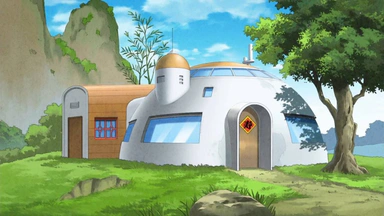
Fifty years before the events of Dragon Ball Z: The World's Strongest, the base was frozen over by an avalanche (which is repeatedly claimed to be the direct result of various gods who were disgusted with the nature of Wheelo's experiments). Dr. Kochin gathers the Dragon Balls and summons Shenron at the beginning of the movie to wish that the fortress, along with Dr. Wheelo inside, would be released from the unmeltable ice. Dr. Kochin then uses the fortress to go to Kame House, where he finds and kidnaps Master Roshi and Bulma.
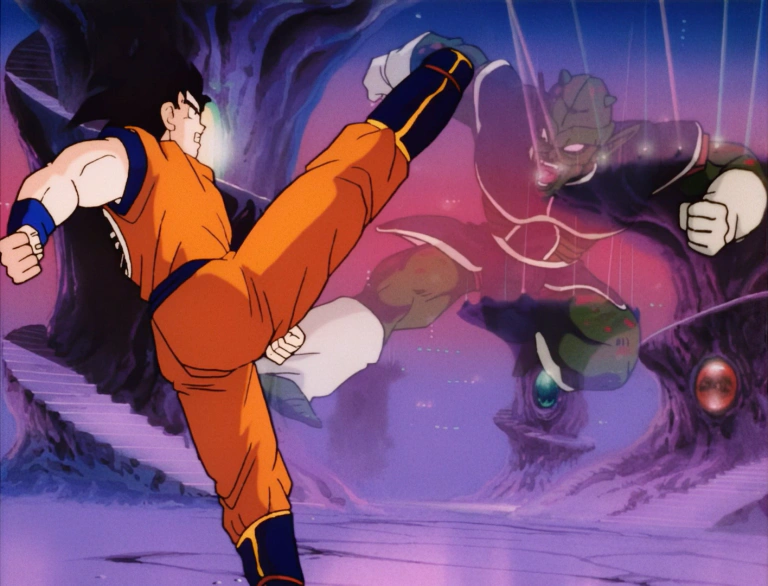
The entrance of the fortress is a heavy steel double door. The first floor contains moving spiked balls, it is where Goku fights Misokatsun. Goku fights Ebifurya and Kishime on the second floor, and a brainwashed Piccolo on the third floor. It is also on the third floor that Master Roshi fights the three Bio-Warriors. On this floor, there is a giant screen and two forcefields; the first forcefield is used by Dr. Kochin to hold Bulma prisoner and the second one is used by Dr. Wheelo to attack Goku. The lab seems to be on the last floor of the fortress.
The fortress was heavily damaged when Goku used his Kaio-ken Kamehameha against Dr. Wheelo and further damaged when Dr. Wheelo used his Photon Strike in an attempt to stop Goku from throwing the Spirit Bomb. After Dr. Wheelo was destroyed by the Spirit Bomb, the fortress generator overloads and explodes - destroying the fortress entirely.
Sources
Adapted from the original article, under CC BY-SA 3.0.